
Blueberries
Lorem ipsum dolor sit amet consectetur. Tristique blandit massa ultricies et vel risus malesuada tristique. At duis malesuadaseget euismod cras.
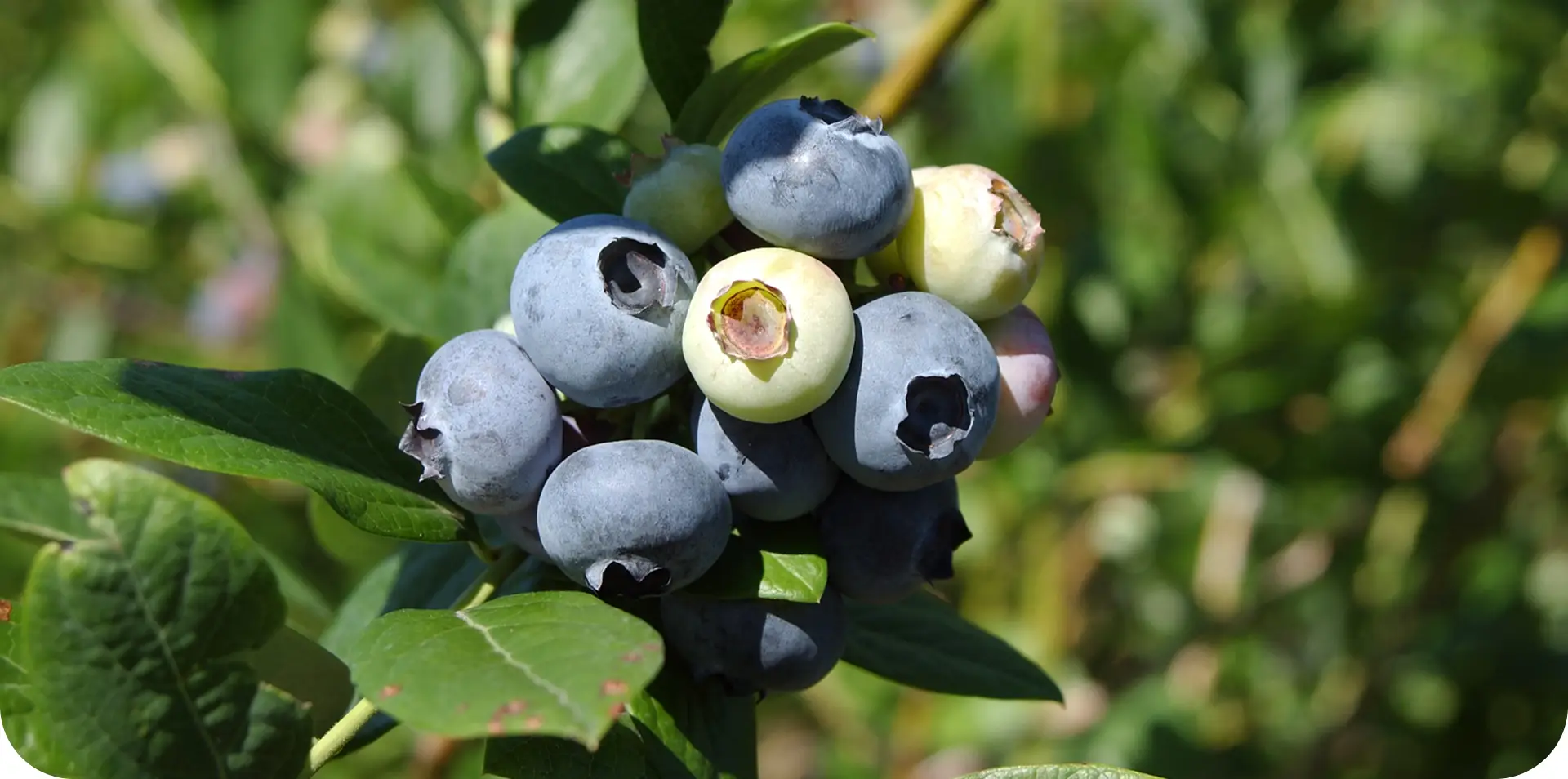
Blueberries are flowering plants in the genus Vaccinium, sect. Cyanococcus. The species are native only to North America. They are shrubs varying in size from 10 cm tall to 4 m tall; the smaller species are known as “lowbush blueberries”, and the larger species as “highbush blueberries”. The leaves can be either deciduous or evergreen, ovate to lanceolate, and from 1-8 cm long and 0.5-3.5 cm broad. The flowers are bell-shaped, white, pale pink or red, sometimes tinged greenish.
The fruit is a berry 5-16 mm diameter with a flared “crown” at the end; they are pale greenish at first, then reddish-purple, and finally indigo on ripening. They have a sweet taste when mature, with variable acidity. Blueberry bushes typically bear fruit from May through October; “blueberry season” peaks in July, which is National Blueberry Month in the United States and Canada.
All species whose English common names include “blueberry” are currently classified in section Cyanococcus of the genus Vaccinium. Several other plants of the genus Vaccinium also produce blue berries which are sometimes confused with blueberries, mainly the predominantly European bilberry (Vaccinium myrtillus), which in many languages has a name that means “blueberry” in English. See the Identification section for more information.
Although blueberries are native to North America, they are now grown also in Australia, New Zealand and South American countries[1], and are air-shipped as fresh produce to markets around the world.
Beginning in 2005, blueberries have been discussed among a category of functional foods called superfruits having the favourable combination of nutrient richness, antioxidant strength, emerging research evidence for health benefits and versatility for manufacturing popular consumer products[3] [4].
Species
- Vaccinium angustifolium (Lowbush Blueberry)
- Vaccinium boreale (northern blueberry)
- Vaccinium caesariense (New Jersey blueberry)
- Vaccinium corymbosum (Northern Highbush Blueberry)
- Vaccinium darrowii (Southern Highbush Blueberry)
- Vaccinium elliottii (Elliot Blueberry)
- Vaccinium formosum (southern blueberry)
- Vaccinium fuscatum (Black Highbush Blueberry; syn. V. atrococcum)
- Vaccinium hirsutum (Hairy-fruited Blueberry)
- Vaccinium koreanum
- Vaccinium myrsinites (Evergreen Blueberry)
- Vaccinium myrtilloides (Canadian Blueberry)
- Vaccinium pallidum (Dryland Blueberry)
- Vaccinium simulatum (upland highbush blueberry)
- Vaccinium tenellum (Southern Blueberry)
- Vaccinium virgatum (Rabbiteye Blueberry; syn. V. ashei)

Identification
True wild blueberries (section Cyanococcus of the genus Vaccinium) occur only in eastern North America. Other sections in the genus, native to other parts of the world including western North America, Europe, and Asia, include other wild shrubs producing similar-looking edible berries such as huckleberries, cranberries, bilberries and cowberries. These are sometimes colloquially called blueberries and sold as blueberry jam or other products.
The names of blue berries in languages other than English often translate as “blueberry”, e.g. Scots Blaeberry and Norwegian Blåbær, although those berries may belong to another species. For example, Blåbær and French myrtilles usually refer to the European native bilberry, while bleuets refers to the North American blueberry.
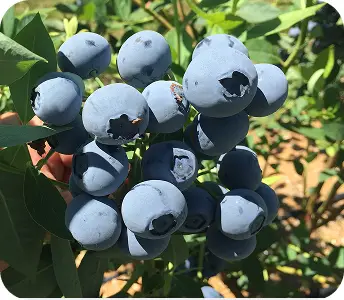
Aside from location of origin, blueberries can be distinguished from bilberries by cutting them in half. Ripe blueberries have white or greenish flesh, while bilberries and huckleberries are colored purple throughout.
Cultivation
Blueberries are cultivated and picked wild. In North America, the most common cultivated species is V. corymbosum, the Northern Highbush Blueberries. Hybrids of this with other Vaccinium species adapted to southern U.S. climates are known collectively as Southern Highbush Blueberries.
Wild blueberries, smaller than cultivated ones, are prized for their intense color. The Lowbush Blueberry, V. angustifolium, is found from Newfoundland westward and southward to Michigan and West Virginia. In some areas it produces natural blueberry barrens, where it is practically the only species covering large areas. Several First Nations communities in Ontario are involved in harvesting wild blueberries. Low bush species are fire-tolerant and blueberry production often increases following a forest fire as the plants regenerate rapidly and benefit from removal of competing vegetation.
There are numerous highbush cultivars of blueberries, each of which have a unique and diverse flavor. The most important blueberry breeding program has been the USDA-ARS breeding program based at Beltsville, Maryland and Chatsworth, New Jersey. This program began when Dr. Frederick Coville of the USDA-ARS collaborated with Ms. Elizabeth White. In the early part of the 20th Century, Ms. White offered wild pickers cash for large fruited blueberry plants. ‘Rubel’, one such wild blueberry cultivar, is the origin of many of the current hybrid cultivars.
Rabbiteye Blueberry (V. virgatum syn. V. ashei) is a southern type of blueberry produced from the Carolinas to the Gulf Coast states.
Other important species in North America include V. pallidum, the Hillside or Dryland Blueberry. It is native to the eastern U.S., but common in the Appalachians and the Piedmont of the Southeast. Sparkleberry, V. arboreum, is a common wild species on sandy soils in the southeastern U.S. Its fruit are important to wildlife, and the flowers important to beekeepers.
View more products
Lorem ipsum dolor sit amet consectetur. Tristique blandit massa ultricies et vel risus malesuada tristique. At duis malesuadaseget euismod cras.