
Blackcurrants
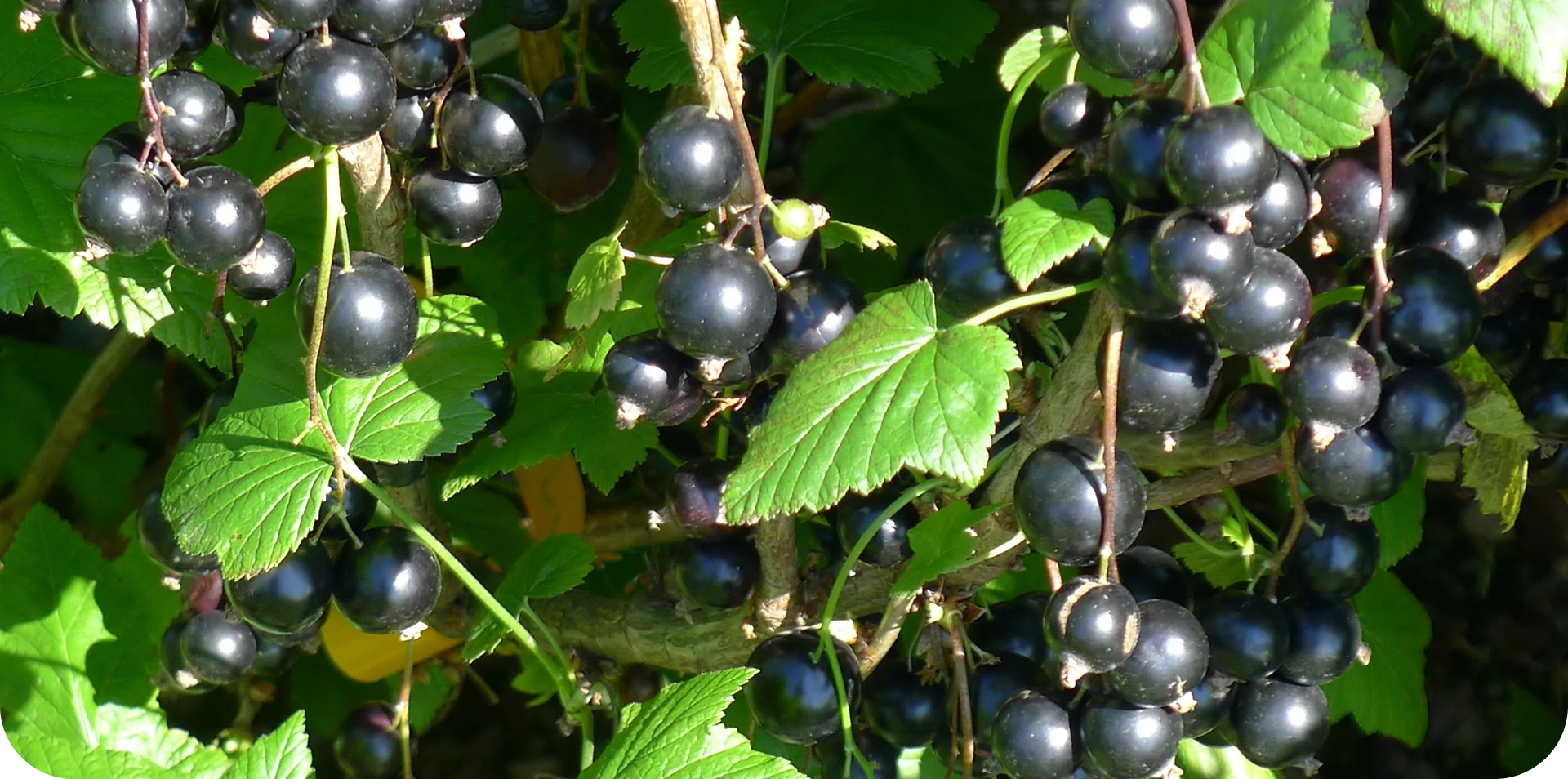
The Blackcurrant (Ribes nigrum) is a species of Ribes berry native to central and northern Europe and northern Asis. In French it is called a “cassis”.
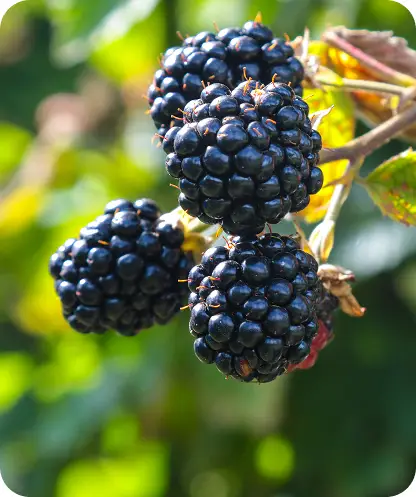
It is a small shrub growing to 1-2m tall. The leaves are alternate, simple, 4-9cm long and broad, and palmately lobed with five lobes, with a serrated margin. The flowers are 4-6mm diameter, with five reddish-green to brownish petals; they are produced in racemes 5-10cm long. The fruit is an edible berry 1cm diameter, very dark purple in colour, almost black, with a glossy skin and a persistent calyx at the apex, and containing several seeds.
Plants from Asia are sometimes distinguished as a separate variety Ribes nigrum var. sibiricum, or even as a distinct species Ribes cyathiforme.
The fruit has a high natural vitamin C content. Like the redcurrant (and unlike the Zante currant, a type of grape which is often dried), it is classified in the genus Ribes.
In addition to the high levels of vitamin C, studies have also shown concentrated blackcurrant to be an effective Monoamine oxidase inhibitor (MAOI) (Bormann, et al 1991.) Fifty grams of 5.5X concentrate was found to inhibit 92% of the Monoamine oxidase enzymes. Blackcurrant seed oil is a dish source of gamma-linolenic acid (GLA), a very rare essential fatty acid.
When not in fruit, the plant looks very similar to the redcurrant shrub; they may be distinguished by the strong odour of the leaves and stems of the blackcurrant [citation need].
In Russia, it is common to infuse slightly sweetened vodka with blackcurrant leaves, making a deep yellowish-green beverage with a sharp flavour and an astringent taste [citation needed]. Blackcurrant berries can also be used to flavour vodka. In the UK, blackcurrant juice is often mixed with cider to make a drink called Cider & Black. This drink can be ordered at most pubs. It is also believed that adding a small amount of blackcurrant to Guinness will bring out a sweeter taste in the beer, making it a better beverage in some beer-drinkers’ opinions.
Blackcurrants have a very sweet and sharp taste, which is both a benefit and a problem in terms of how and where it is used. Blackcurrants are made into jelly, jam, juice, ice cream, cordial and liqueur, but less is eaten fresh compared to the past.
In the UK, Europe and Commonwealth countries, some types of confectionery include a blackcurrant flavour, but this is generally missing in the United States, even within the same brand. Instead grape flavour in candy (including grape jelly) almost mirrors the use of blackcurrant in both its ubiquity in the USA, and its rarity on the eastern side of the Atlantic.
Also see https://en.wikipedia.org/wiki/Blackcurrant
Winterwood and Blackcurrants
Winterwood was historically the largest seller of Blackcurrants to the UK supermarket, but consumer preferences have changed, and unfortunately sales have reduced now to a very low level, although in the UK season, fresh Blackcurrants can still be found in many UK supermarkets, just not sold in such large quantities.
Winterwood is still probably the largest seller of fresh Blackcurrants to the UK supermarkets, but sales are now more often measured in tens of tonnes compared to historic highs of several hundred tonnes
Since around 2005, Winterwood has partnered with the James Hutton Institute (JHI – https://www.hutton.ac.uk/scientific-services/improving-crop-production/breeding/blackcurrants-and-redcurrants-breeding/ ) ,previously the Scottish Research Institute, with the objective of producing a Blackcurrant that is edible fresh without sugar or mixing with other sweeter items to make it palatable as a standalone eating experience.
The humble Blackcurrant has the potential of being a superfood, with potential to be even healthier then the Blueberry, but this is never going to be known as such a superfood unless it its taken up by the wider population for fresh (as opposed to the juice in drinks, often then with unhealthy amounts of sugar).
To widen the consumption, Winterwood believes the way forward is to make it more palatable through breeding, in order to make the sugar:acid balance more acceptable.
Great progress has ben made but it is a very slow process. Seedlings now in trial are a massive step forward to when this process started over 20 years ago, but probably still another decade to go before there is a variety that is going to be acceptable to the general consumer, and then there wil be an uphill marketing and educational hurdle to overcome, so Winterwood is very keen not to prematurely release something that is not quite right.
Watch this space!!
View more products
Lorem ipsum dolor sit amet consectetur. Tristique blandit massa ultricies et vel risus malesuada tristique. At duis malesuadaseget euismod cras.